
For a while, I was confused about the differences between subjects like manifold calculus, differential geometry, and differential topology. This post discusses my current understanding of how these subjects are defined relative to each other.
(Of course, such a delineation may not need to be too sharp, but it is useful nonetheless to gain clarity in this area of math.)
First, we have the concept of manifolds, which we can define most generally in topology. Absent of any additional structure, we can call their study the “theory of manifolds” or something like that — there doesn’t seem to be a specific term generally used to delineate this subject.
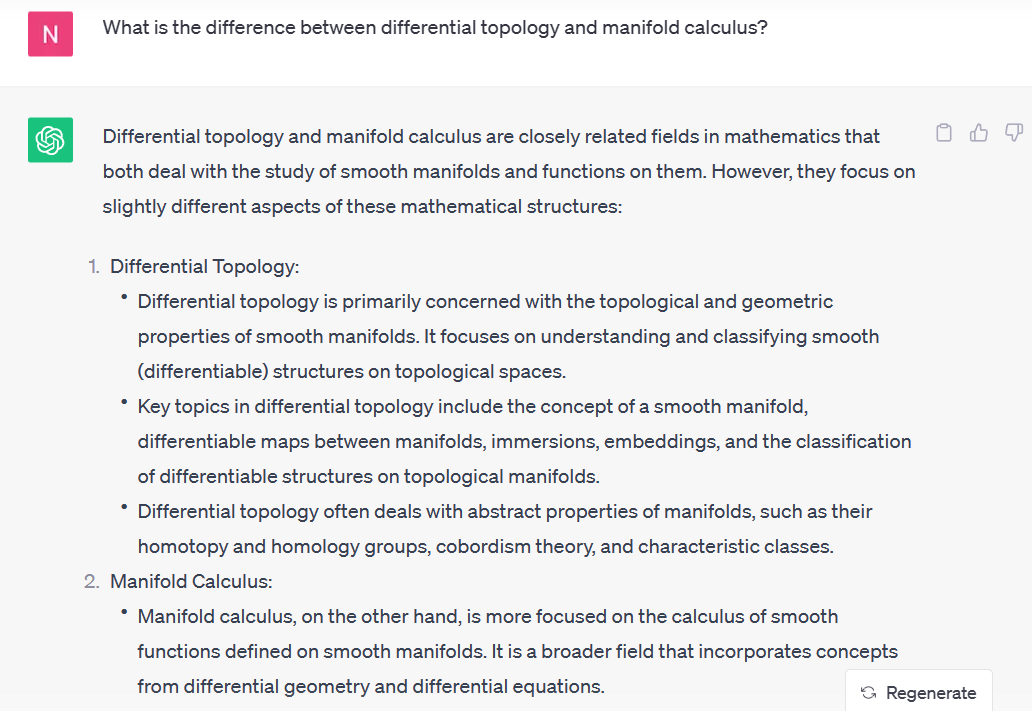
Some manifolds can be equipped with a structure that makes them differentiable. The subjects of differential topology and manifold calculus (or synonymously, analysis on manifolds) are both at this scope, but according to ChatGPT, differential topology concerns itself more with the study of differentiable manifolds directly, while manifold calculus concerns itself more with the study of calculus notions for functions on these manifolds. Both together comprise the study of differentiable manifolds.
Going further, some differentiable manifolds can be equipped with additional “geometric” structure. The study of these would now be called differential geometry. (The Wikipedia article on differential topology delves further into comparing and contrasting differential geometry and differential topology; that discussion seems to generally align with what are we saying here too.)
We have multiple types of differentiable manifolds with geometric structure, leading correspondingly to multiple branches of differential geometry. For example, the study of Riemannian manifolds is Riemannian geometry, while the study of symplectic manifolds is symplectic geometry.
I don’t know enough about differential geometry to tell whether it is possible to have non-differentiable manifolds with geometric structure, but in that case manifold geometry would be an apt name for the study of all manifolds with geometric structure, differentiable or not. This would then be broader than differential geometry, the sum of differential geometry and the study of non-differentiable manifolds with geometric structure.
Like differential topology, differential geometry is often concerned with directly studying differentiable manifolds with geometric structures, looking for example at their geometric properties; the calculus of functions on these manifolds would still fall under (and presumably be labeled as) manifold calculus.
While Riemannian geometry and symplectic geometry are considered branches of differential geometry, it doesn’t seem that differential geometry is often considered a branch of differential topology, even though we can define differential geometry to be similar in nature to differential topology, but specially for manifolds with geometric structure. This may be similar to the distinction between ring theory and group theory — although all rings are special cases of groups, we don’t consider ring theory to be a branch of group theory, since the additional structure of the ring leads to sufficiently different theory to have ring theory “feel different” than just a branch of group theory. In a similar way, the additional geometric structure may give differential geometry a different enough character that differential topology and differential geometry are considered to be similar and related, but not with one contained within the other.
